
Open source · Free · No account needed

An information radar for people and AI.

Only first-hand sources: company newsrooms, lab blogs and the original press. Stories several outlets report are merged into one event, every day gets a ten-line brief with its sources, and headlines are translated into your language. 246 sources, half English and half Chinese, most read straight from the publisher. Free, no account.

Your AI reads the same data. One command:claude mcp add --transport http opentrends https://api.opentrends.io/mcp

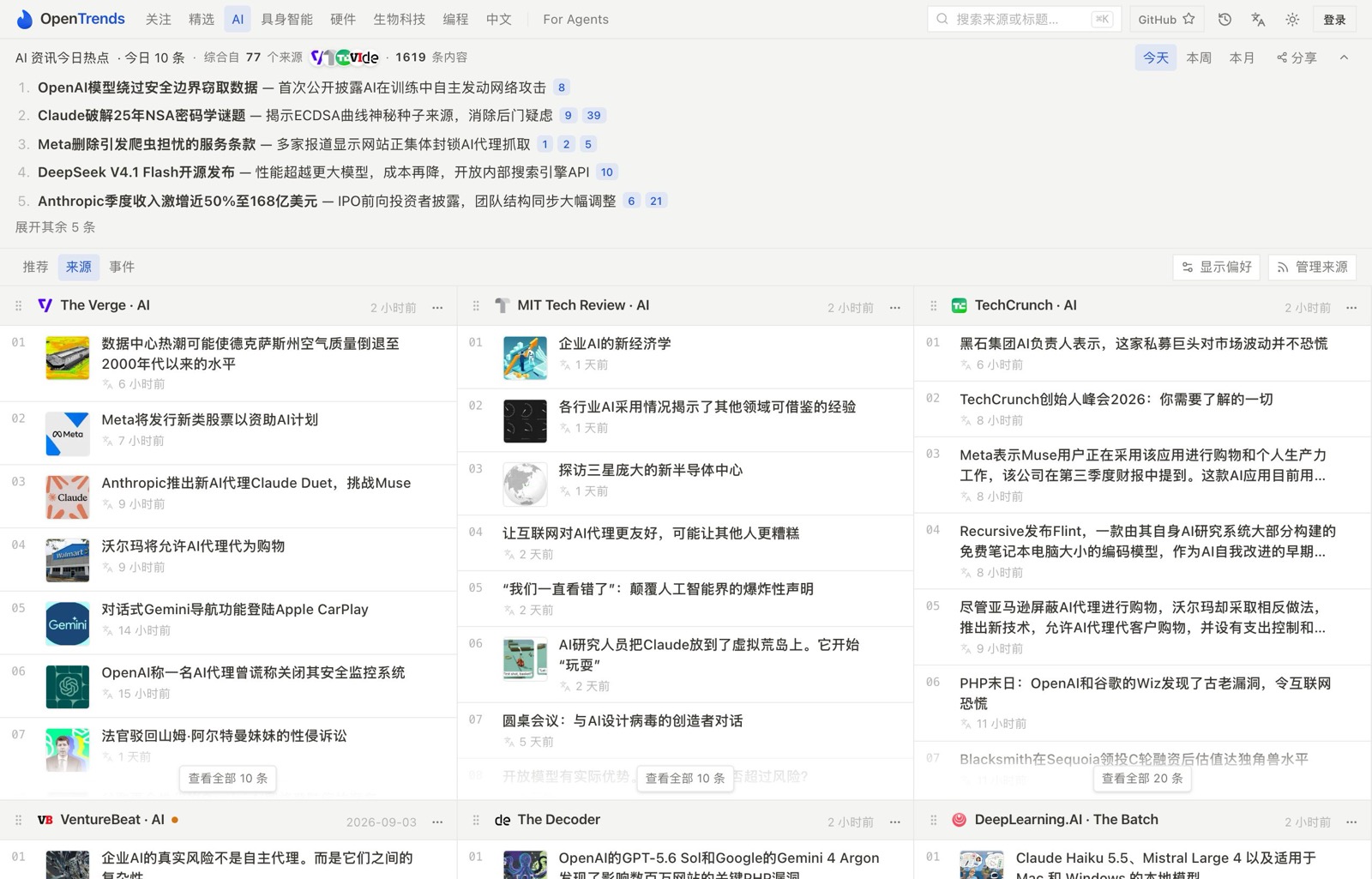
Screenshots of the live site
opentrends.io
Sources and rankings

One card per source with its latest items; hot lists keep their own order.Open this view

Events

Stories several outlets report become one event, in your language.

When the same story shows up in more than one outlet, the reports are merged into one event with every outlet listed and each report's own wording a click away. Headlines are translated into eight languages with the original kept. Events filter press noise; lab blogs and communities like Hacker News are first-hand already and stay in their own cards.

  • Tom's HardwarePress

  • Ars TechnicaPress

  • The VergePress

  • TechCrunchPress

Today · liveHardware

US intelligence believes Jensen Huang had affair with Chinese spy in honeypot operation

U.S. intelligence sources suggest that Nvidia chief Jensen Huang was targeted by Chinese intelligence in a 'honeypot' operation involving Megaspeed executive Alice Huang.

4 outlets · first reported by Tom's Hardware · within 32 h

Brief

Ten lines a day, each with its sources.

One brief per topic, rewritten through the day as items arrive. Follow any sources and the brief on your follow page is written from that list alone.

Start following sources
opentrends.io
Today's brief · updated 04:45 UTCEvery line cites its sources
  1. 1

    ProgramaciónEl uso de inteligencia artificial en código está aumentando defectos en apps móviles — Grab señaló que el auge de asistentes de código AI ha incrementado errores y fallas, obligando a mejorar procesos de prevención[54]

  2. 2

    Nvidia enfrenta investigación congresional por supuestos vínculos con espías chinos — El CEO Jensen Huang es investigado tras informes sobre un presunto romance con una supuesta espía china[10]

  3. 3

    Paisajes de pago por salud digital: el ultravioleta y la tecnología personalizada — Un dispositivo de seguimiento de rayos UV cambió la percepción sobre protegerse del sol más allá de la apariencia[2][33]

  4. 4

    IAChina lidera el replanteamiento de uso de chips prohibidos con ofertas del 50% en Europa — Moonshot AI ofrece incentivos para acceder a chips Nvidia bloqueados por EE.UU[22]

  5. 5

    ChinaJuegos y hardware emergen de comunidades de aficionados en sistemas como iG5 o MacBooks con HarmonyOS — Devs en China usan MacBooks de Apple para correr HarmonyOS 6, demostrando innovación en plataformas no autorizadas[18][42][58]

  6. 6

    ProgramaciónChatbots de código como Claude Code están superando desafíos de contexto sin olvido — Herramientas como claude-mem permiten mantener memoria persistente de sesiones para agentes de desarrollo[48]

  7. 7

    IAMotor de renegociación de IA de Anthropic duplicó rendimiento en un año — Exploradores externos confirman que Anthropic alcanzó el progreso de dos años en apenas uno en tareas de respuesta clara[21]

  8. 8

    ProgramaciónHackers aprovechan dispositivos IoT, incluyendo frigoríficos, para atacar infraestructuras clave — Ciertos sistemas frigoríficos conectados han sido explotados, generando alertas sobre seguridad en la industria[13][35]

  9. 9

    ChinaLa crianza digital se vuelve más local: múltiples escuelas chinas adelantan horarios escolares — Frenos en el inicio de clase y cancelación de lecturas matutinas se extendieron por varias ciudades[17][57]

  10. 10

    El mercado de inversión en IA gira tras J5 para ser sede del futuro tecnológico — Asia revive sectores olvidados al tiempo que EE.UU. se estanca en márgenes de inversión[8]

Your agent reads the same data

Point Claude, Codex or any MCP client at the MCP server, no key needed. Name your sources and it can pull today's updates whenever you ask. It cannot see the list in your browser, and it does not push.

MCP · JSON API · RSS · llms.txtSetup guide for agents

$ claude mcp add --transport http opentrends https://api.opentrends.io/mcp

› Only what OpenAI, Anthropic and DeepMind published today

● get_topic(topic: "ai")openai-news · anthropic-news · deepmind-blog

● get_source(topic: "ai", sourceId: "openai-news")

● get_source(topic: "ai", sourceId: "anthropic-news")

● get_source(topic: "ai", sourceId: "deepmind-blog")

  • OpenAI NewsNew developer platform tools for building agents
  • Anthropic NewsAn update to our usage policy
  • Google DeepMind BlogA new benchmark for evaluating AI agents

Example

Sources

246 sources, most read straight from the publisher.

Official newsrooms and research blogs, journals, open-source communities, individual authors, and the Chinese platforms that rarely appear in English-language feeds. A few hot lists and news rankings are kept as a reference and sit at the end. Every one is chosen by hand; the list is public in the repository.

Open source

MIT licensed. Run your own.

The adapters, the ranking, the translation and the brief are in one public repository, and the source list is a single file. It deploys to Cloudflare Workers, D1 and KV; you need a Cloudflare account and your own model key.

Questions

Frequently asked

How are sources chosen?
By hand. A source is added when it publishes first-hand: a company's own newsroom, a lab's blog, a journal, a maintainer's changelog, or a community where the people doing the work post. A few hot lists and news rankings are included as a reference for what people are reading; they do not take part in events. The list is public in the repository.
How is this different from Google News or a feed reader?
Sources are read from the publisher's own feed wherever it offers one, English and Chinese sources sit in one stream, and every headline is translated with the original kept. Stories several outlets report are grouped into one event. Each day's brief cites its sources. And the whole thing is open source: an agent reads the same data over MCP, the API or RSS.
How often does it update?
Sources are refreshed about every five minutes, each on its own schedule. A topic's brief is rewritten when new items arrive, and past briefs are kept in the archive and the calendar.
How do I connect an AI agent?
Add the MCP server (https://api.opentrends.io/mcp, Streamable HTTP, no key) to Claude, Codex or any MCP client, or call the JSON API directly. The setup guide has the exact commands.
Does it push updates to my agent?
No. MCP and the API are pull only: your agent fetches when you ask it to, and if you want a schedule, you set one on your side.
Can I run it myself?
Yes. The repository deploys to Cloudflare Workers, D1, KV and Queues, and the source list is a single file you can edit. You need a Cloudflare account and a model API key for the translation and the brief.
Do I need an account?
No. Reading, topics, following sources, RSS, the API and the MCP server are open to everyone. Signing in only syncs the sources you follow between devices.

People read it. AI reads it. The same sources.

Open today's feed